




Blake Fulenwider Chrysler Dodge Jeep Ram of Snyder

Blog

Ram 3500 Dually vs. Single Rear Wheel: Which One Do You Need?

snyder_ram_3500_dually_vs_single_rear_wheel

Choose a dually (DRW) Ram 3500 when your trailer's pin weight is high enough to eat up a single rear wheel truck's payload — heavy goosenecks, big fifth wheels, hotshot loads. Choose single rear wheel (SRW) when you want most of the capability with a narrower, cheaper-to-run truck you can park anywhere. Payload, not tow rating, is usually what decides it.

What "dually" actually means

A dually has four tires on the rear axle instead of two, under wider rear fenders. Those two extra tires do three things: they raise how much weight the rear axle can legally carry, they spread the load across more rubber, and they give the truck a wider stance that fights trailer sway. A single rear wheel Ram 3500 has the same frame, the same cab options and the same engines — it just carries less on the back end.

Both are Ram 3500s. Around here people still say "Dodge 3500," and we know exactly what you mean.

Dually vs. single rear wheel: the comparison

Dually (DRW)Single rear wheel (SRW)
Rear tiresFourTwo
Payload ceilingHighest — the reason to buy oneLower, but still heavy duty
Trailer stabilityBetter; wider rear track resists swayGood, but less margin in crosswinds
Tire replacementSix tiresFour tires
Width / parkingWide fenders; tight in town and in a garageParks like a 2500
Best forHeavy gooseneck, big fifth wheel, hotshot, flatbedStock trailer, equipment trailer, daily driving

Across the 2026 Ram 3500 lineup, maximum payload runs up to 7,590 pounds and GVWR up to 14,000 pounds when properly equipped, with maximum gas towing up to 18,150 pounds. The 3500 starts at $48,155. Ram publishes towing and payload as separate ratings, and they are not interchangeable — more on that below.

Payload is the number that decides it

Here's the math that sends people to a dually. A gooseneck trailer puts roughly 20–25% of its loaded weight down on the ball, and that weight counts as payload, not towing.

  • A 20,000-pound loaded gooseneck puts about 4,000–5,000 pounds in your bed.
  • Add two people, a full fuel tank, a toolbox and a couple of round bales' worth of gear.
  • Now compare that total to the payload on your door jamb sticker.

A single rear wheel truck can run out of payload long before it runs out of tow rating. That's not a Ram problem — it's physics and it's the law. If you're regularly over, the dually isn't a luxury, it's the correct truck.

When single rear wheel is the smarter buy

Plenty of people buy a dually they don't need. If you pull a two- or three-horse gooseneck, a 20-foot stock trailer, or a bumper-pull equipment trailer, an SRW 3500 — or even a Ram 2500 — will do the work and be easier to live with.

Reasons to stay single rear wheel:

  • Cost of ownership. Four tires instead of six, every time.
  • Width. Dually fenders are wide. Drive-thrus, alleys off the square in Snyder, older garages and county road cattle guards all get tighter.
  • Resale in a mixed market. SRW trucks appeal to both work buyers and family buyers.
  • Ride when empty. An unloaded dually is a stiff truck.

Do you need a dually for a fifth wheel?

Not always. Mid-size fifth wheels sit comfortably inside an SRW 3500's ratings. Large triple-axle fifth wheels and toy haulers usually do not. Weigh your trailer loaded the way you actually travel — with water, propane, gear and the side-by-side in the back — then check the pin weight against payload. Dry weight on the brochure has fooled a lot of buyers.

Diesel, chassis cab and the work-truck version of this question

If you're buying for a business, the dually question usually comes bundled with a chassis cab question. A Ram 3500 or 5500 chassis cab with a flatbed or service body is a different truck than a pickup with a gooseneck ball — and often the right one for hotshot, welding and oilfield service work. We keep chassis cabs in stock specifically because of the work that happens around here; see Ram 3500 chassis cab inventory and our commercial and BusinessLink page for upfits, priority service and loaners.

Buying used: what to check on a used Ram 3500 dually

Used duallies work for a living, so inspect accordingly:

  1. All six tires — matched brand, matched wear, correct load rating. Inner rears hide problems.
  2. Gooseneck or fifth-wheel hardware — how it was installed and what it's been pulling.
  3. Service records on the diesel — oil intervals, fuel filters, emissions work.
  4. Frame and bed behind the rear axle — where overloading shows up.
  5. Brakes — the first thing heavy towing eats.

We keep a deep used heavy-duty lot — browse used Ram 3500s, including duallies — and our used inventory runs Ram, Chevrolet, Ford, GMC and Toyota, so we're happy to compare honestly across brands.

What this looks like in Scurry County

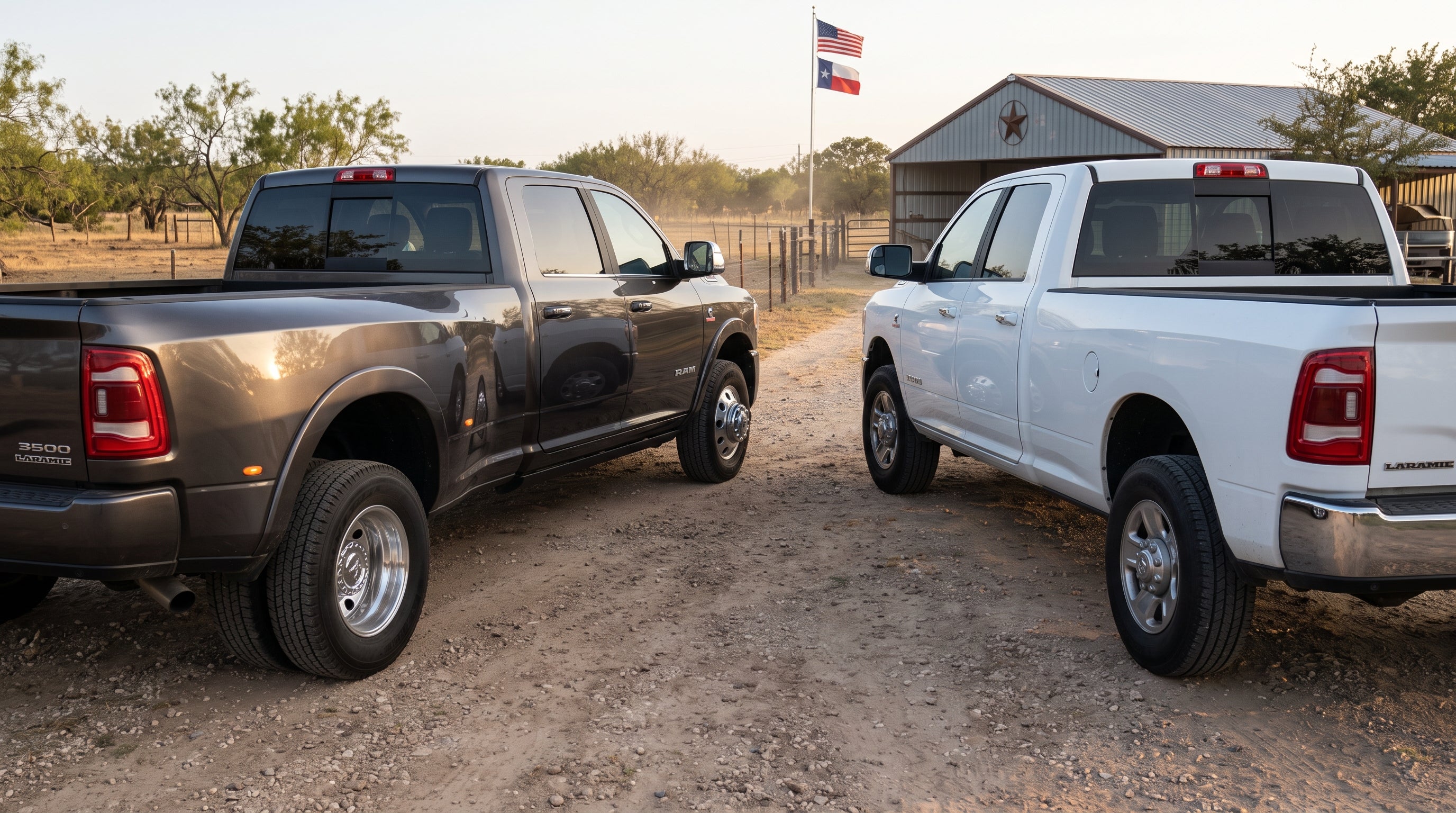
Between cotton stripping season, 4-H and FFA show season at the Scurry County Coliseum, oilfield service work in the SACROC unit and everything that gets hauled up and down US-84, we sell more heavy duty trucks than anything else. Two of every three new units on our lot is a Ram, and heavy duty is the biggest slice. If you want to see an SRW and a dually parked side by side and walk around both, we've got them.

Why buy from Blake Fulenwider CDJR of Snyder

We're the only Chrysler, Dodge, Jeep and Ram dealer in Scurry County, and the nearest one for Colorado City, Roby, Rotan, Post, Hermleigh, Ira and Fluvanna. We'll tell you the number over the phone, appraise your trade the same day, and we won't run your credit until you're ready. Every 2026 Ram 3500 carries a 10-year/100,000-mile powertrain warranty.

Call sales at 325-515-0137, get your trade value, or get directions to 305 16th St, Snyder. Hablamos español.

Related FAQs

What is the difference between a Ram 3500 dually and single rear wheel?

A dually has four rear tires under wider fenders; a single rear wheel truck has two. The dually carries more weight on the rear axle and resists trailer sway better. The single rear wheel version is narrower, cheaper to run on tires, and easier to park. Frame, cabs and engines are otherwise the same.

Do I need a dually to pull a gooseneck?

Only if the pin weight exceeds what a single rear wheel truck can carry. A gooseneck puts about 20–25% of its loaded weight into the bed, so a 20,000-pound trailer can add 4,000–5,000 pounds of payload. Weigh your trailer loaded and compare it to the payload on your door jamb sticker.

How much can a Ram 3500 carry?

Maximum payload on the 2026 Ram 3500 is up to 7,590 pounds with a GVWR up to 14,000 pounds when properly equipped, and maximum gas towing is up to 18,150 pounds. Your truck's exact ratings depend on cab, bed, drivetrain and axle, and are listed on the door jamb label.

Is a dually harder to drive every day?

It's wider, not harder. The extra width shows up in drive-thrus, older garages, parking spaces and narrow county roads, and an empty dually rides stiffer than a single rear wheel truck. Most people adjust within a week. If the truck spends most of its life unloaded, single rear wheel is usually the better daily driver.

Does a dually cost more to maintain?

The main difference is tires — six instead of four, every replacement cycle. Oil changes, filters and brake service are comparable. Ask our service department for a maintenance estimate on the specific truck you're considering; we're open Saturdays 7:30 to 4.

Where can I find a used Ram 3500 dually near Snyder, Texas?

Blake Fulenwider CDJR of Snyder keeps a deep used heavy duty lot at 305 16th St in Snyder, and we're the closest CDJR store for Colorado City, Post, Rotan and Hermleigh. Browse used Ram 3500 inventory online or call 325-515-0137 and we'll tell you what's on the ground today.
Recommended Posts

blake-fulenwider-snyder-tx-ram-3500-tow

How Much Can a Ram 3500 Tow?

Updated November 2026 Quick answer: A properly equipped 2026 Ram 3500 tows up to 36,610 pounds with a gooseneck or fifth-wheel hitch and the 6.7L Cummins High Output diesel in dual-rear-wheel form. Conventional bumper-pull towing tops out at 23,000 pounds on the diesel. The 6.4L HEMI V8 version tows up to 18,150 pounds. Your truck's exact rating is on the door-jamb sticker. Ram 3500 towing capacity by engine and rear axle (2026) The number everybody quotes — 36,610 pounds — belongs to one specific truck: a 3500 dually with the High Output Cummins and a gooseneck or fifth-wheel hitch. Most 3500s on our lot and on Scurry County lease roads are rated lower than that, and the differences come down to three choices: engine, single or dual rear wheels, and how you hook the trailer up. 2026 Ram 3500 configuration Max conventional (bumper-pull) Max gooseneck / fifth-wheel Engine output 6.4L HEMI V8, single rear wheel 17,730 lb Same as conventional 405 hp / 429 lb-ft 6.4L HEMI V8, dual rear wheel 18,150 lb Same as conventional 405 hp / 429 lb-ft 6.7L Cummins HO, single rear wheel 23,000 lb 26,080 lb 430 hp / 1,075 lb-ft 6.7L Cummins HO, dual rear wheel 23,000 lb 36,610 lb 430 hp / 1,075 lb-ft Two rules sit underneath that table. Ram requires a fifth-wheel or gooseneck hitch for any trailer over 23,000 pounds on a 3500, and the Class V receiver on a 3500 is limited to 2,300 pounds of tongue weight. That second rule is the one that quietly caps a lot of bumper-pull setups out here: a 20,000-pound bumper-pull trailer loaded tongue-heavy can hit the 2,300-pound limit before it hits the 23,000-pound limit. How much can a Ram 3500 carry in the bed? (Payload) Payload is where the 3500 earns its keep over a 2500, and where the two sources we checked disagree the most. Ram's own 2026 HD chart lists payload truck-by-truck rather than as one number; third-party guides quote a 7,590-pound maximum for the gas dually, and roughly 6,050 pounds for the diesel dually. Single-rear-wheel diesels land in the 4,000-to-4,400-pound range at base trim. The reason payload falls as you add the Cummins is simple: the diesel engine weighs more, and every pound of truck comes out of the pounds you're allowed to carry. For Scurry County, payload matters most to two groups: oilfield service outfits running a welding rig, hot-shot bed, or a flatbed full of tools, and ranchers hauling a gooseneck livestock trailer. A gooseneck trailer puts 15 to 25 percent of its loaded weight on the hitch, and that pin weight counts against payload, not towing. A 30,000-pound loaded gooseneck can put 6,000 pounds on the ball. That is the single spec that pushes a Snyder buyer from a 3500 single-rear-wheel to a dually, and it's why we keep asking what you're putting in the truck, not just behind it. Gas or diesel for towing in West Texas? The 6.4L HEMI V8 makes 405 horsepower and 429 pound-feet, and it tows 17,000 to 18,000 pounds. For a two-horse trailer, a 24-foot cattle trailer, or a flatbed with a side-by-side and feed, that is plenty, and the gas truck costs less to buy and less to service. The 6.7L Cummins High Output makes 430 horsepower and 1,075 pound-feet, and that torque figure is the reason it tows 36,610 pounds. Torque is what gets a loaded gooseneck moving from a dead stop on a caliche lease road, and what holds speed on the long grade into Post on US-84 with a southwest headwind. Out here, the honest rule of thumb: if you tow more than about 15,000 pounds more than a few times a month, or you tow anything heavy for a living, buy the Cummins. If the trailer is lighter and the truck is mostly a crew-cab commuter to the SACROC unit, the HEMI is the better value. The figures above are for the High Output Cummins; Ram's 2026 chart notes a standard-output Cummins with lower ratings is also built, so check which one is under your hood before you trust a number. Single rear wheel or dually for towing? A single-rear-wheel 3500 diesel tows 23,000 pounds conventional and 26,080 pounds gooseneck. That covers most ranch and oilfield trailers. The dually raises the gooseneck ceiling to 36,610 pounds and, more importantly for stability, puts four tires under the pin instead of two. On a windy day on I-20 between Sweetwater and Big Spring, a loaded gooseneck behind a dually sways noticeably less. The trade-off is width: a dually is wider at the hips, harder to park at the Coliseum on a show weekend, and the outer tires chew on narrow county-road shoulders. We wrote a whole guide on that choice — see Ram 3500 dually vs single rear wheel. Ram 3500 vs Ram 2500: when do you need the one-ton? The 2500 and 3500 share cabs, beds and engines. What changes is the rear suspension, the axle ratings and the gross weight the truck is certified to carry. If your loaded trailer is under 20,000 pounds and your pin or tongue weight is under about 3,000 pounds, a 2500 does the job and rides softer empty. The moment you're pulling a 30-foot gooseneck livestock trailer loaded, a 20,000-pound-plus equipment trailer, or a fifth-wheel camper, the 3500's payload headroom is what keeps you legal. Our Ram 2500 towing guide covers the 2500's numbers. Which Ram 3500 should you pick for the trailer you pull? What you tow around Snyder Typical loaded weight Ram 3500 we'd point you to Two-horse bumper-pull, 4-H/FFA show trailer 5,000–8,000 lb 6.4L HEMI, single rear wheel 24-ft gooseneck stock trailer, loaded 14,000–18,000 lb Cummins HO, single rear wheel Oilfield equipment trailer, skid steer or mini-ex 18,000–24,000 lb Cummins HO, single or dual rear wheel 32-ft gooseneck livestock trailer or fifth-wheel camper 24,000–30,000 lb Cummins HO, dual rear wheel Hot-shot flatbed or heavy equipment 30,000 lb and up Cummins HO dually, or a 3500/5500 chassis cab If your work is heavier than any row in that table, the answer is usually a Ram 3500 or 5500 chassis cab with a flatbed or service body rather than a pickup. Towing a trailer in Texas: three things to know Texas requires trailer brakes on trailers with a gross weight over 4,500 pounds, so nearly every trailer a 3500 pulls needs a brake controller — every 2026 Ram HD can be ordered with an integrated one. If the combined weight of truck and trailer is over 26,001 pounds and you're hauling for hire, you're into Class A CDL territory; ranchers moving their own livestock are generally covered by the farm exemption, but confirm your situation with DPS. And weigh the rig once, at a certified truck scale, so you know your real pin weight. Why Buy at Blake Fulenwider CDJR of Snyder Blake Fulenwider CDJR of Snyder is at 305 16th St, Snyder, TX 79549 — the only Chrysler, Dodge, Jeep and Ram dealer in Scurry County, and the nearest one for Colorado City, Roby, Rotan, Post, Hermleigh, Ira and Fluvanna. We'll give you the price over the phone. We'll appraise your trade the same day, in writing. And we won't run your credit until you're ready. Every 2026 Ram 3500 is covered by Ram's 10-year/100,000-mile powertrain warranty — Cummins included — which is the proof point that matters most when the truck is how you make a living. We're also a Stellantis BusinessLink dealer: priority service bays, loaners and an upfit allowance for working trucks. Read our customer reviews — including the one-star ones — before you drive over. We'd rather you know exactly who you're dealing with. Call Sales at 325-515-0137 · Get Your Trade Value · Get Pre-Approved (No Impact on Your Credit) · Hours & Directions · Hablamos español. Related FAQs What is the maximum towing capacity of a 2026 Ram 3500? A properly equipped 2026 Ram 3500 dually with the 6.7L Cummins High Output diesel is rated to tow up to 36,610 pounds with a gooseneck or fifth-wheel hitch. Conventional bumper-pull towing is capped at 23,000 pounds. Gas 6.4L HEMI models tow up to 18,150 pounds. Check the door-jamb sticker for your truck's exact rating. Does a Ram 3500 need a gooseneck hitch to tow its maximum? Yes. Ram requires a fifth-wheel or gooseneck hitch for any trailer over 23,000 pounds on a 3500, and the Class V receiver hitch is limited to 2,300 pounds of tongue weight. Anything heavier than a mid-size gooseneck stock trailer needs the in-bed hitch to reach the truck's full rating. How much can a Ram 3500 single rear wheel tow? A 2026 Ram 3500 single-rear-wheel with the Cummins High Output diesel tows up to 23,000 pounds conventional and 26,080 pounds with a gooseneck or fifth-wheel. The gas 6.4L HEMI single-rear-wheel tows up to 17,730 pounds. That covers most ranch, livestock and oilfield trailers around Snyder without stepping up to a dually. How much can a Ram 3500 diesel tow versus a gas Ram 3500? The 6.7L Cummins High Output makes 430 horsepower and 1,075 pound-feet and tows up to 36,610 pounds. The 6.4L HEMI V8 makes 405 horsepower and 429 pound-feet and tows up to 18,150 pounds. For heavy goosenecks and daily towing, the diesel's torque wins; for lighter trailers and lower purchase cost, the gas truck makes sense. What is the payload capacity of a Ram 3500? Third-party 2026 guides list up to 7,590 pounds of payload for a gas Ram 3500 dually and about 6,050 pounds for the diesel dually; single-rear-wheel diesels run roughly 4,000 to 4,400 pounds. Ram rates payload truck by truck, so confirm your exact figure on the door-jamb sticker before loading a heavy gooseneck. Is a Ram 3500 too much truck for ranch work near Snyder? Not if you pull a loaded gooseneck. A 3500's extra payload is what carries 4,000 to 6,000 pounds of pin weight legally. If your heaviest trailer is a two-horse or a 24-foot stock trailer, a Ram 2500 may ride softer and cost less. Bring your trailer weights and we'll run the numbers with you.

How Much Can a Jeep Grand Cherokee Tow?

A properly equipped 2026 Jeep Grand Cherokee is rated to tow up to 6,200 pounds with the available trailer-tow package, and the three-row Grand Cherokee L carries the same 6,200-pound maximum. That is enough for a bass boat, a small two-horse trailer or a utility trailer with a side-by-side, and not enough for a loaded gooseneck. Your exact rating depends on engine and equipment and is printed on the door-jamb label. What determines how much a Grand Cherokee can tow? Three things set the number: the engine, whether the vehicle has the factory trailer-tow package (hitch receiver, wiring, cooling and trailer-sway control calibrated together), and the body — two-row Grand Cherokee or three-row Grand Cherokee L. Four-wheel drive and trim level change the rating far less than they do on a pickup. Without the tow package the rating drops sharply, so when you look at a used Grand Cherokee on our lot or anywhere else, check for the factory receiver and the seven-pin connector before you believe a listing's tow claim. As with any vehicle, the figure that governs your trailer is on the tire-and-loading label inside the driver's door of the specific unit, not a brochure maximum. Ask us for it; we will read it to you over the phone. Grand Cherokee towing by model and powertrain Model Powertrain Max towing, properly equipped Fits a Scurry County… Grand Cherokee (two-row) 2.0L Hurricane 4 Turbo — 324 hp / 332 lb-ft 6,200 lb Bass boat to Lake J.B. Thomas, utility trailer, small camper Grand Cherokee (two-row) 3.6L Pentastar V6 — 293 hp / 260 lb-ft 6,200 lb Same loads; the value engine on Laredo Grand Cherokee L (three-row) 2.0L Hurricane 4 Turbo or 3.6L V6 6,200 lb Family of six plus the boat or a two-horse bumper pull Whatever the engine, these are mid-size SUV ratings — roughly half of what a Ram 1500 tows — and that is the right way to think about the Grand Cherokee: a family vehicle that can pull a weekend trailer, not a truck substitute. Is a Grand Cherokee enough for what people tow around Snyder? For a lot of families, yes. The trailers that show up behind SUVs here are a 16- to 18-foot aluminum bass boat headed to Lake J.B. Thomas or up US-84 to Lake Alan Henry, a single-axle utility trailer with a side-by-side for the lease, a small pop-up or teardrop camper for Lake Colorado City State Park, and the occasional two-horse straight-load for a daughter's barrel racing. Loaded, those run from about 2,500 to 5,500 pounds, which is inside a properly equipped Grand Cherokee's rating with a margin left for tongue weight and a full load of people. Where it stops is the stock trailer. A 20-foot gooseneck with show steers for the Scurry County Coliseum, a three-horse slant with a tack room, a flatbed with hay — those are pickup loads by weight and by hitch type, and a Grand Cherokee has no bed for a gooseneck ball. If that is your trailer, the Ram 2500 is the right starting point, and a Ram 1500 covers the heavier bumper-pulls in between. Towing capacity versus payload in a Grand Cherokee Payload — people, luggage and the trailer's tongue weight — is the limit a loaded family SUV reaches first. Six people in a Grand Cherokee L, a week's gear for the lake, and a 500-pound tongue weight will use most of the vehicle's payload while the boat is well under the tow rating. The payload figure is on the same door label as the tow rating. If you regularly fill every seat and tow, the Grand Cherokee L's higher payload and longer wheelbase are the reasons to choose it over the two-row, more than the third row itself. What equipment should a towing Grand Cherokee have? The factory trailer-tow package, which includes the Class IV receiver, a seven- and four-pin connector, heavy-duty engine cooling and the trailer-sway control integration. Add a brake controller if the trailer has brakes — Texas requires brakes on trailers over 4,500 pounds gross weight — and use a weight-distributing hitch if you are near the top of the rating, because a southwest crosswind on I-20 between Sweetwater and Big Spring will push a tall trailer around. The Quadra-Trac and Quadra-Drive four-wheel-drive systems earn their keep on a slick boat ramp or a caliche county road after a rain, which is the more common off-pavement situation here than rock crawling. Which Grand Cherokee trim should a Snyder family choose for towing? Any trim tows the same rated load once it has the tow package; you are paying for comfort and features above Laredo. Laredo and Altitude are where most of our Grand Cherokee buyers land because they keep the payment within reach of a Snyder ISD household, and the tow package is available on them. Limited and Summit add the leather, the larger screens and the air suspension, which levels the vehicle nicely with a trailer on. Go to the Grand Cherokee L if you need the third row or the extra payload. We keep both body styles in stock — browse new Grand Cherokee inventory to see what is on the lot today, or read the 2026 Grand Cherokee model page for trim-by-trim details. Why Buy at Blake Fulenwider CDJR of Snyder Blake Fulenwider CDJR of Snyder is at 305 16th St, Snyder, TX 79549 — the only Chrysler, Dodge, Jeep and Ram dealer in Scurry County, and the nearest one for Colorado City, Roby, Rotan, Post, Hermleigh, Ira and Fluvanna. We'll give you the price over the phone. We'll appraise your trade the same day, in writing. And we won't run your credit until you're ready. Our used lot is a general-market lot — if you are trading a Tahoe, Explorer or 4Runner for a Grand Cherokee, we will put a same-day written number on it. Read what our customers say at our reviews page, including the one-star reviews — we would rather you see the whole picture. Call Sales at 325-515-0137 · Get Your Trade Value · Get Pre-Approved (No Impact on Your Credit) · Get Directions · Hablamos español. Related FAQs Can a Jeep Grand Cherokee pull a boat? Yes. A typical 16- to 20-foot aluminum or fiberglass bass boat on a single- or tandem-axle trailer weighs roughly 2,500 to 4,500 pounds loaded, which is within a properly equipped Grand Cherokee's 6,200-pound rating. Four-wheel drive helps on the ramps at Lake J.B. Thomas and Lake Alan Henry. Can a Grand Cherokee tow a horse trailer? A small two-horse bumper-pull with two average horses can land near 5,000 pounds loaded, which is close to the top of a Grand Cherokee's rating with little margin for tack and passengers. For regular horse hauling, especially three-horse or gooseneck trailers, a Ram 1500 or Ram 2500 is the safer match. Does the Grand Cherokee L tow more than the Grand Cherokee? No. The two share powertrains and both carry a 6,200-pound maximum when properly equipped; confirm each on the door-jamb label. The L's advantage for towing families is payload and wheelbase — more weight allowance for passengers plus tongue weight, and more stability with a trailer behind it. Do I need the trailer-tow package to tow with a Grand Cherokee? Practically, yes. Without the factory package the rating is far lower, and you lose the integrated hitch, wiring, upgraded cooling and trailer-sway control calibration. On a used Grand Cherokee, check for the factory receiver and seven-pin connector before relying on a listing's tow figure. Is a Grand Cherokee or a Ram 1500 better for towing around Snyder? If towing is regular and heavy — stock trailers, equipment, anything gooseneck — the Ram 1500 or a Ram 2500 is the answer. If towing is occasional and the vehicle is primarily a family SUV for school runs, church and the lake, the Grand Cherokee's rating covers it comfortably.

How Much Can a Ram 1500 Tow?

A properly equipped 2026 Ram 1500 is rated to tow up to 11,610 pounds with the standard-output 3.0L Hurricane inline-six, and up to 11,320 pounds with the 5.7L HEMI V8 eTorque. Your truck's real number depends on engine, cab, bed, axle ratio and 4x4, and it sits on the door-jamb sticker, not in a brochure. Most Scurry County trailers — a 20-foot stock trailer, a bass boat, a two-horse bumper pull — land well inside that figure. What determines a Ram 1500's towing capacity? Five things, in order of how much they move the number: the engine, the axle ratio, the cab and bed combination, 4x2 versus 4x4, and whether the truck has the factory trailer-tow package. A regular-cab 4x2 with the long bed and the tallest tow gearing will post the highest rating; a loaded Crew Cab 4x4 with a short box will post a lower one, because the truck itself weighs more and every pound of truck comes out of the pound-rating for the trailer. That is why two Lone Star crew cabs sitting side by side on our lot can carry different ratings. The only number that matters for your truck is on the tire-and-loading label inside the driver's door and the trailer-tow label beside it. If you are shopping, ask us for the rating on the specific unit before you ask about the payment — we will read it to you over the phone. How much does the 2026 Ram 1500 tow by engine? The 5.7L HEMI V8 with eTorque is back for 2026 and it is the engine most of our Snyder buyers ask for by name. It makes 395 horsepower and 410 lb-ft of torque and is rated to tow up to 11,320 pounds. The 3.0L Hurricane inline-six is the other choice in the lineup, and in standard-output form it actually carries the highest rating of the bunch at 11,610 pounds. Maximum payload across the lineup is up to 2,360 pounds. Engine Output Max towing (properly equipped) Who picks it here 3.0L Hurricane I-6 (standard output) 420 hp / 469 lb-ft 11,610 lb Buyers who want the top tow rating and the best fuel economy under load 5.7L HEMI V8 eTorque 395 hp / 410 lb-ft 11,320 lb Ranch, lake and 4-H/FFA haulers who want the V8 sound 3.0L Hurricane I-6 (high output) 540 hp / 521 lb-ft 10,000 lb Buyers who want the quickest half-ton rather than the highest rating 3.6L Pentastar V6 eTorque 305 hp / 269 lb-ft 8,130 lb Commuters on US-84 who tow a few times a year Keep in mind the maximum rating is a best-case configuration. A crew cab 4x4 will typically rate a few hundred to a couple thousand pounds below the headline figure, which is still comfortably above what most bumper-pull trailers in Scurry County weigh loaded. Is a Ram 1500 enough truck for what people tow around Snyder? For most of the trailers we see, yes. A 16- to 20-foot bumper-pull stock trailer with a few head of show calves for the Scurry County Coliseum, a 14-foot utility trailer with a side-by-side headed to a lease, a bass boat going to Lake J.B. Thomas or up US-84 to Lake Alan Henry, a two-horse straight-load — those loads live in the 4,000- to 8,000-pound range loaded, and a HEMI or Hurricane crew cab handles them with margin to spare. The half-ton rides better empty than a three-quarter ton, costs less to buy and insure, and fits in a Snyder ISD pickup line. Where the half-ton runs out is weight on the hitch, not weight behind it. A gooseneck or fifth-wheel puts 15 to 25 percent of the trailer's weight straight onto the bed, and that pin weight eats a Ram 1500's payload long before you reach its tow rating. If you are pulling a gooseneck stock trailer with a full load, a three-deck of cattle, a 30-foot flatbed with a skid steer to a SACROC lease road, or anything with air brakes, you are a Ram 2500 or 3500 customer. We wrote up how much a Ram 2500 can tow and when a Ram 3500 dually makes sense for exactly that line. Towing capacity vs. payload: which one do I run out of first? Payload — what the truck can carry in the cab and bed, including people, tongue weight and the dog — is the limit most half-ton owners hit first without knowing it. Four adults, a cooler, a toolbox and a 700-pound tongue weight from a tandem-axle trailer will use most of a crew cab's payload while the trailer itself is nowhere near the tow rating. The payload figure is also on the door-jamb label, and it is specific to the truck as it left the factory. Options add weight to the truck and subtract it from payload, which is one reason a Tradesman or Express often carries more payload than a loaded Limited. What does the Ram 1500 need to tow safely in West Texas? Three practical things. First, a brake controller — any trailer over 4,500 pounds in Texas needs its own brakes, and the integrated controller in the trailer-tow group is worth having over an aftermarket box. Second, a weight-distributing hitch for heavier bumper-pulls; it levels the truck and keeps the front tires planted when a southwest crosswind hits you on I-20 between Sweetwater and Big Spring. Third, patience with speed: the trailer's tires are usually rated lower than the truck's, and West Texas heat shortens their life. Highway miles help here. A used Ram 1500 that has spent its life on US-84 and US-180 between Snyder, Post and Colorado City is generally an easier truck than one that has idled in town traffic, so when you look at a used half-ton on our lot, ask where it came from. Which 2026 Ram 1500 trim should a Snyder buyer tow with? Lone Star is the Texas-only trim and it is what most of our new Ram 1500 inventory in Snyder wears, because it bundles the equipment West Texas buyers actually use — the HEMI is available, the trailer-tow group is available, and the price sits well below Laramie. Express is the value crew cab and starts at $44,495 including destination; it is the truck for a first-time buyer who tows a boat a few weekends a year. Tradesman is the work-spec truck with the highest payload potential. Every 2026 Ram 1500 — whichever trim — carries the 10-year/100,000-mile powertrain warranty, which matters when the truck will spend a decade hauling. See the 2026 Ram 1500 model page for trim-by-trim details. The 2026 Ram 1500 with the HEMI was named Full-Size Pickup of Texas at the Texas Truck Rodeo in October 2025 — Ram's eighth straight year — and that panel tows on Texas roads for a living. Why Buy at Blake Fulenwider CDJR of Snyder Blake Fulenwider CDJR of Snyder is at 305 16th St, Snyder, TX 79549 — the only Chrysler, Dodge, Jeep and Ram dealer in Scurry County, and the nearest one for Colorado City, Roby, Rotan, Post, Hermleigh, Ira and Fluvanna. We'll give you the price over the phone. We'll appraise your trade the same day, in writing. And we won't run your credit until you're ready. Every 2026 Ram 1500 we sell carries a 10-year/100,000-mile powertrain warranty — the engine and transmission that do the towing are covered for the length of most truck loans. Read what our customers say at our reviews page, including the one-star reviews — we would rather you see the whole picture. Call Sales at 325-515-0137 · Get Your Trade Value · Get Pre-Approved (No Impact on Your Credit) · Get Directions · Hablamos español. Related FAQs Does the Ram 1500 tow more with the HEMI or the Hurricane? The standard-output 3.0L Hurricane inline-six carries the Ram 1500's top rating of 11,610 pounds when properly equipped. The 5.7L HEMI V8 eTorque is rated to 11,320 pounds, and the high-output Hurricane to 10,000. For the trailer you actually pull, the rating on your specific truck's door-jamb label is the number to trust, and we will read it to you before you buy. Can a Ram 1500 pull a gooseneck trailer? Physically, yes, with a bed hitch, but the pin weight of a loaded gooseneck stock or flatbed trailer usually exceeds a half-ton's payload before you approach its tow rating. For gooseneck work around Scurry County — cattle, equipment, hay — a Ram 2500 or 3500 is the right truck, and we stock both in depth. What is the difference between towing capacity and payload? Towing capacity is the maximum trailer weight the truck can pull. Payload is what it can carry in the cab and bed, including passengers, cargo and the trailer's tongue weight. Half-ton owners usually run out of payload first, so check both figures on the door label when matching a truck to a trailer. Do I need a brake controller to tow with a Ram 1500 in Texas? Texas requires brakes on trailers over 4,500 pounds gross weight, which means you need a controller in the truck. The factory trailer-tow group includes an integrated controller that is better matched to the truck than an add-on box, and it is the setup we recommend for stock, horse and equipment trailers. Which Ram 1500 trim is best for towing? Any trim with the same engine and the trailer-tow group tows the same rated load; the differences are comfort and price. Lone Star is the Texas trim most of our buyers choose, Express is the value crew cab from $44,495 including destination, and Tradesman offers the highest payload potential for work use. Is a used Ram 1500 a good towing truck? Yes, if it has the trailer-tow equipment and a clean service history. Trucks with highway miles on US-84 and I-20 are generally easier on drivetrains than town-driven trucks. We appraise and inspect every used Ram on our lot and will tell you its tow rating before you drive it.